

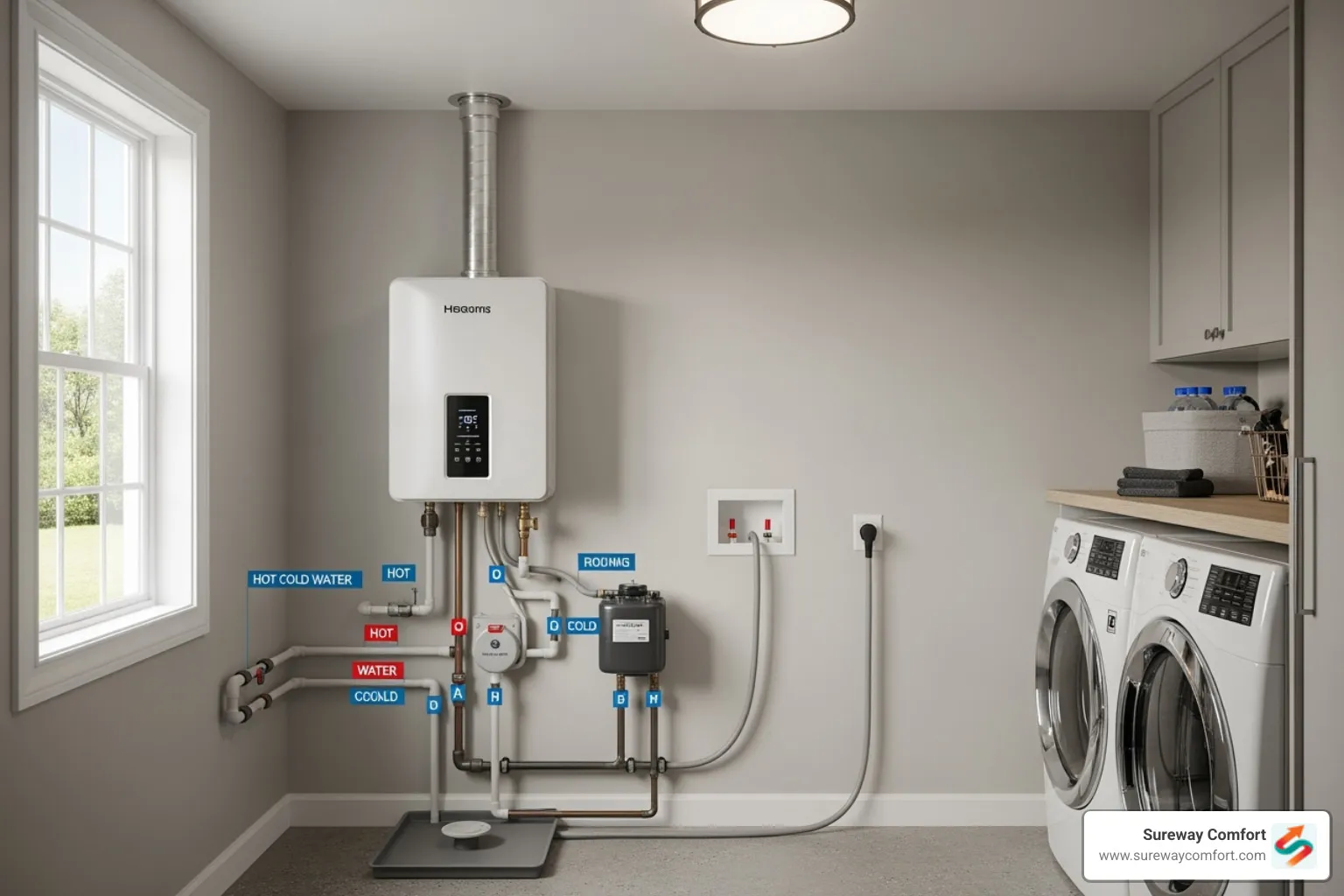
We are often taught from a young age that heat kills germs. While that is true for boiling a pot of pasta, the warm water sitting in your apartment’s pipes and water heater is a different story entirely. In the historic and high-rise locations of Hoboken, your hot water tap may actually be carrying risks that your cold water tap does not.
From the accelerated leaching of heavy metals to the growth of specialized bacteria, the “hot” side of your faucet is a distinct chemical and biological environment. In 2026, as Hoboken continues to update its century-old infrastructure, residents are finding that their hot water requires a different level of scrutiny. If you’ve ever used hot tap water to speed up your morning coffee or fill a baby bottle, it’s time to understand why that shortcut might be riskier than you think.
1. The “Solvent” Effect: Heat and Heavy Metals
Water is often called the “universal solvent,” and heat significantly supercharges its ability to dissolve materials. In an older city like Hoboken, many buildings still contain legacy plumbing materials specifically lead solder and brass fixtures.
- Lead Leaching: Hot water is significantly more corrosive than cold water. When hot water sits in your building’s pipes, it dissolves lead and copper much faster. According to the Environmental Protection Agency (EPA), you should never use water from the hot tap for drinking or cooking.
- The “First-Draw” Trap: Hot water often stands for long periods in your water boiler and internal risers. This extended contact time, combined with high temperatures, means that the lead levels in your hot water can be many times higher than those in your cold water.
For families in older brownstones, this is a critical safety point. Using hot tap water for infant formula is one of the most common ways children are inadvertently exposed to lead.
2. The “Goldilocks Zone” for Legionella
While lead is a chemical risk, the hot water system also presents a biological one: Legionnaires’ Disease. Legionella is a type of bacteria that thrives in the very environment provided by apartment water heaters and large-scale boiler systems.
- The Temperature Problem: Legionella grows best at temperatures between $20^{\circ}\text{C}$ and $45^{\circ}\text{C}$ ($77^{\circ}\text{F}$–$113^{\circ}\text{F}$). If your building’s hot water heater is set too low to save energy or prevent scalding, it creates a “Goldilocks Zone” where bacteria multiply rapidly.
- Aerosolization: The risk isn’t just from drinking the water. You contract Legionnaires’ by breathing in tiny droplets of contaminated water. This happens most often while showering, using a humidifier, or even standing near a running faucet.
In 2026, many local-quality standards recommend keeping hot water stored at a minimum of $60^{\circ}\text{C}$ ($140^{\circ}\text{F}$) to kill these pathogens, but many older Hoboken buildings struggle to maintain these temperatures consistently across all floors.
3. Sediment and Scale: The “Stomach” of Your Building
Your water heater acts as a settling tank for your entire apartment. Over years of operation, the minerals and sediment found in Hoboken’s municipal water settle at the bottom of the tank.
As these minerals (like calcium and magnesium) bake onto the heating elements, they form scale. This scale doesn’t just reduce efficiency; it provides a “biofilm” or a protective home for bacteria. If a water main break occurs nearby a frequent event in Hudson County the surge of sediment can enter your building and get trapped in the hot water tank, creating a murky, mineral-rich environment that can affect the taste, odor, and safety of your water for weeks.
4. Disinfection Decay: Heat vs. Chlorine
Hoboken’s water is treated with chlorine or chloramines to keep it sterile. However, heat causes these disinfectants to “off-gas” or break down much faster.
When water is heated and stored in a building’s tank, the protective chlorine residual that the city worked hard to maintain begins to vanish. Without that chlorine, the water is vulnerable to re-contamination. This is why we often highlight on our blog that “treated” city water can become “untreated” water simply by sitting in a warm tank in your basement.
How to Protect Your Household
Knowing the risks is half the battle. Here are the steps every Hoboken resident should take to manage their hot water safety:
- The “Cold-Only” Rule: Only use the cold water tap for drinking, cooking, and making ice. If you need hot water, draw it cold and heat it on the stove or in a kettle.
- Flush After Disuse: If you’ve been away for a weekend, run your hot water for several minutes to flush out any stagnant water where bacteria may have grown.
- Check the Temp: If you have access to your own water heater, ensure it is set to at least $49^{\circ}\text{C}$ to $60^{\circ}\text{C}$ ($120^{\circ}\text{F}$–$140^{\circ}\text{F}$). If you are worried about scalding, use a thermostatic mixing valve at the tap rather than lowering the tank temperature.
- Professional Services: If you live in a large complex, ask your management about their maintenance schedule for the boiler and if they have a Legionella management plan.
At Olympian Water Testing of Hoboken NJ, we offer specialized services that include sampling from both hot and cold taps. This “comparative analysis” can tell you if your building’s hot water system is adding lead or bacteria to your supply.
Conclusion: Respect the Temperature
We often view our hot and cold taps as two ends of the same pipe, but chemically and biologically, they are worlds apart. In an urban environment like Hoboken, your hot water system is a complex machine that requires constant vigilance. By sticking to the cold tap for consumption and ensuring your hot water is kept at the right temperature for hygiene, you can enjoy the best of city living without the hidden risks.