

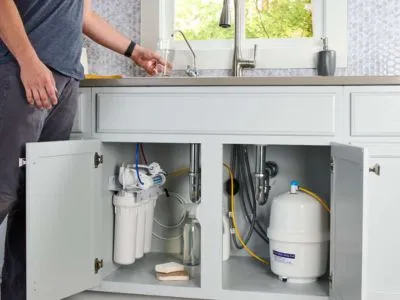
In the “Mile Square City,” where modern glass high-rises overlook century-old brownstones, a silent struggle is playing out in the kitchen sinks of young families. Over the past year, many residents in the 2nd Ward and near the Lackawanna Terminal have taken proactive steps to protect their children from lead and contaminants by installing under-sink or faucet-mounted filters. Yet, in early 2026, a surprising number of these Hoboken households are still receiving “failed” laboratory results.
If you have already spent the money on a filtration system but are still seeing elevated lead or bacterial levels, you are not alone. The reality of Hoboken’s aging infrastructure combined with the complexities of modern filtration means that a filter is often just the beginning of the solution, not the end. At Olympian Water Testing of Hoboken NJ, our services have helped many residents bridge the gap between “filtered” and “safe.”
The Certification Trap: Not All Filters Stop Lead
One of the most common reasons Hoboken families fail water tests after installing a filter is a simple misunderstanding of certification labels. Many popular filters sold in local big-box stores are designed primarily for “aesthetic effects.”
- NSF/ANSI 42: This certification means the filter removes chlorine taste and odor. It makes your water taste like bottled water, but it is not a health standard.
- NSF/ANSI 53: This is the critical certification for lead reduction.
We frequently see households that have installed high-end-looking systems that only carry the NSF 42 mark. In a city where nearly 15% of service lines are estimated to contain lead, using a taste-only filter is like wearing a raincoat that isn’t waterproof. To truly protect against local risks, a filter must be specifically certified to reduce lead under the NSF 53 protocol.
The “Last Mile” Re-Contamination
Even with a perfect NSF 53-certified filter, the location of the filter matters. Many Hoboken apartment buildings utilize “Whole-House” filtration systems in the basement. While these systems are great for the building’s overall local-quality, they have a major blind spot: the building’s own internal pipes.
If your water is filtered in the basement but then travels through 100 feet of old lead-soldered copper or galvanized steel to reach your fourth-floor unit, it can pick up lead along the way. This “re-contamination” is why we often find failing results at the kitchen tap even when the building’s main filter is working perfectly. In Hoboken, the only way to be sure is to test the water at the specific locations where you actually drink it.
Construction Hazards and “Particulate Lead”
As we move through 2026, Hoboken is a hub of water main replacement work. While this is great for the city’s future, the physical vibrations from construction on Washington Street or Observer Highway can shake loose tiny flakes of lead and rust from the interior of pipes.
These “lead slugs” are tiny, solid particles. Most carbon-block filters are designed to chemically bond with dissolved lead, but they can be physically overwhelmed by a sudden influx of particulate lead. If your filter’s aerator or screen isn’t cleaned regularly a step often missed in basic maintenance these particles can sit against the filter media and slowly leach lead into your “filtered” water.
The Hot Water Mistake
A mistake we often highlight on our blog is running hot water through a filter. Most household water filters are strictly designed for cold water use. Hot water can damage the internal filter media, causing it to “release” the contaminants it has already trapped a process known as breakthrough.
Furthermore, hot water is more corrosive and leaches lead from plumbing more effectively. If a resident uses the filtered tap for hot tea or cooking pasta, they are likely bypassing the filter’s effectiveness entirely.
Filter Saturation in a “High-Sediment” City
Because of Hoboken’s older pipes, our water often has higher levels of sediment and rust than suburban areas. This sediment acts like a “pre-filter,” clogging the fine pores of your lead-removal filter much faster than the manufacturer’s 6-month estimate.
When a filter becomes saturated with sediment, the water may find “channels” or paths of least resistance through the carbon block. When this happens, the water spends almost no time in contact with the lead-removing material. We have tested many filters that were only 3 months old but were already failing because they were “spent” early due to the high volume of local pipe debris.
Why Physical Lab Testing is the Only Answer
Many families rely on the “little green light” on their filter to tell them the water is safe. Unfortunately, these lights usually only measure time or volume not the actual chemistry of the water. They don’t know if your lead levels are 5 ppb or 50 ppb.
Professional laboratory testing provides:
- Chemical Accuracy: We measure down to parts per billion, far more sensitive than any home “test strip.”
- Particulate vs. Dissolved Analysis: We can tell if the lead is coming from the city’s pipes or your own faucet.
- Peace of Mind: For families with infants on formula, “probably safe” isn’t good enough.
Conclusion: Your Filter is a Tool, Not a GuaranteeInstalling a filter is a great first step, but it is not a “set it and forget it” solution for Hoboken families. Between the city’s active construction, the age of our building’s pipes, and the nuances of filter certification, there are many ways for lead to bypass your defenses.
If you have installed a filter but haven’t verified its performance with a post-installation lab test, you might be drinking the very contaminants you’re trying to avoid. True safety comes from data, not just hardware.