

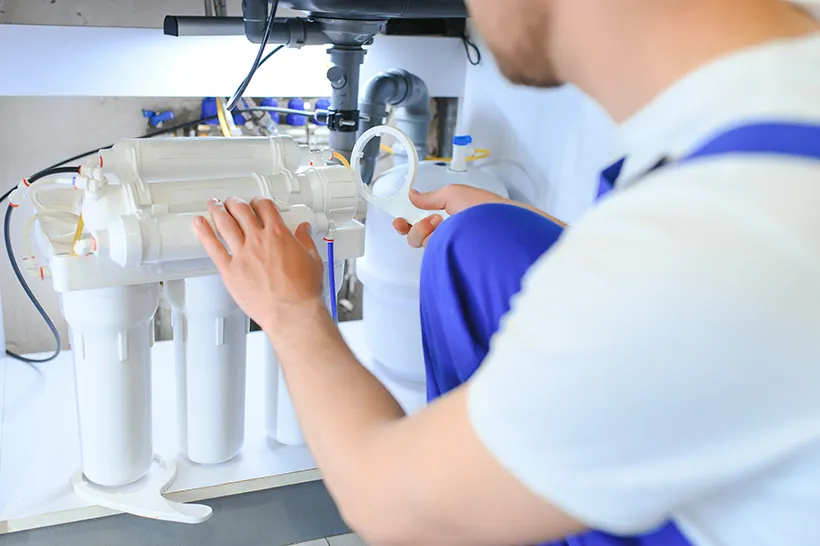
In the competitive real estate landscape of Hoboken, “building-wide filtration” has become a premier marketing highlight. From the luxury waterfront condos along River Street to the newly renovated multi-family units in the North End, property managers and condo boards often tout these industrial-sized systems as the ultimate solution for water purity. For a resident, the promise is simple: the water is cleaned at the source, so every drop in your apartment from the shower to the kitchen sink is pristine.
However, as we progress through 2026, data from locations across the Mile Square City is revealing a more complex reality. At Olympian Water Testing of Hoboken NJ, we frequently encounter residents who are shocked to find that their water fails safety tests despite living in a “filtered building.” The truth is that while building-wide systems are a fantastic first line of defense, they are not a catch-all guarantee of tap safety.
The Point of Entry (POE) Blind Spot
The fundamental limitation of building-wide filtration lies in its placement. These systems are typically installed at the “Point of Entry” (POE) the basement or utility room where the city water main meets the building’s internal plumbing.
The filter treats the water as it enters the structure. While this effectively removes sediment and chlorine from the municipal supply, it creates a massive “blind spot.” Once the water leaves the filter, it must travel through a labyrinth of internal risers, horizontal branch lines, and individual unit valves before it ever reaches your glass. In many of Hoboken’s historic or mid-century buildings, this “last mile” of plumbing is exactly where the contamination occurs.
The Lead Solder and Brass Problem
Even if the water leaving a basement filter is 100% lead-free, it can be re-contaminated within the walls. Many buildings in Hoboken, even those that have undergone cosmetic renovations, still contain copper pipes joined with lead-based solder (legal until 1986) or older brass fixtures that leach lead into the water.
When “purified” water sits stagnant in these internal pipes overnight, it acts as a solvent, pulling metals directly from the building’s own infrastructure. A basement filter cannot stop lead from leaching into the water three floors above it. This is why our services prioritize testing at the specific tap where the water is consumed, rather than relying on the building’s general specifications.
The Chlorine Paradox: Removing the Disinfectant
Most building-wide filtration systems utilize large carbon beds designed to remove chlorine. While this is great for the taste of your water and the health of your skin in the shower, it creates a secondary risk: microbial growth.
Chlorine is added by the city to act as a “residual disinfectant,” keeping the water sterile as it moves through the pipes. When a building-wide system removes all the chlorine at the basement level, the water in the rest of the building is left unprotected. If the building has any “dead legs” (pipes that are capped off or rarely used) or older storage tanks, bacteria like Legionella or coliform can begin to grow in the now-unprotected water.
As we have discussed on our blog, removing chlorine too early in a large plumbing network can inadvertently turn a building’s internal pipes into a breeding ground for biofilms.
Maintenance and Filter Breakthrough
A building-wide filter is a mechanical system that requires rigorous maintenance. In large condo associations or rental complexes, these schedules can sometimes slip. When a large-scale filter becomes “saturated,” it can experience “breakthrough” a phenomenon where the trapped contaminants are suddenly released back into the water stream in high concentrations.
Furthermore, if the filter media isn’t backwashed or replaced correctly, it can become a source of contamination itself. We have seen instances where the local-quality of water entering the building was actually superior to the water leaving the “spent” building-wide filter.
Construction-Related Sediments and Surges
In 2026, Hoboken is seeing a surge in utility work, including the Water Main Replacement Program. This construction can cause sudden pressure surges and “slugs” of sediment to hit a building’s intake.
While a building-wide filter is designed to handle a steady flow of water, these sudden surges can overwhelm the system. High pressure can cause “channeling,” where water carves a path through the filter media without being treated, or it can dislodge “particulate lead” that was previously trapped in the building’s own service lines. For residents, this means that even in a “filtered building,” a nearby construction project on Washington Street can still result in a temporary water safety failure at your tap.
The Need for Point-of-Use (POU) Verification
Because of the many variables between the basement filter and your kitchen faucet, the only way to ensure tap safety is through independent verification. Residents should not assume that the building’s annual “boiler room” test applies to their specific unit.
1. “First Draw” Testing This is the only way to see if the building’s internal pipes are leaching lead or copper into your water while you sleep. 2. Bacterial Screening Especially important in buildings that remove chlorine, ensuring that no biofilms have taken up residence in your unit’s plumbing. 3. Comparative Analysis By testing both the unfiltered and “filtered” water, we can determine if the building-wide system is actually performing as promised or if it has become a liability.
Steps for Hoboken Residents in “Filtered” Buildings
If you live in a building that advertises whole-house or building-wide filtration, you should still take proactive steps:
- Ask for the Log: Request the most recent maintenance and filter-change logs from your building manager or condo board.
- Clean Your Aerators: Even with a big filter, your individual faucet aerators can trap lead and sediment from the pipes within your own walls.
- Flush the Lines: If you’ve been away for the weekend, run your taps for two minutes to clear out the “stagnant” water that has been sitting in your unit’s pipes without chlorine protection.
- Get an Unit-Specific Test: Use our contact page to schedule a test that specifically looks at the water coming out of your faucet.
Conclusion: Data Over Marketing
A building-wide filtration system is a valuable asset and a great step toward better water quality. However, it is not an impenetrable shield. In an urban environment as old and complex as Hoboken, the “last mile” of plumbing is often the most dangerous.
True water safety is found in data, not in a real estate brochure. By verifying the quality of the water at your actual tap, you can ensure that the “filtered” promise of your building is a reality for your family.